

When the response become the damage
Outcomes often belong to the reaction more than the original trigger
👋 Hey, I’m Aruna. Surface Tension is my weekly exploration of insights and thought provoking quotes from the books I read, bundled into one idea worth sitting with. For more, browse my book notes and long form articles.
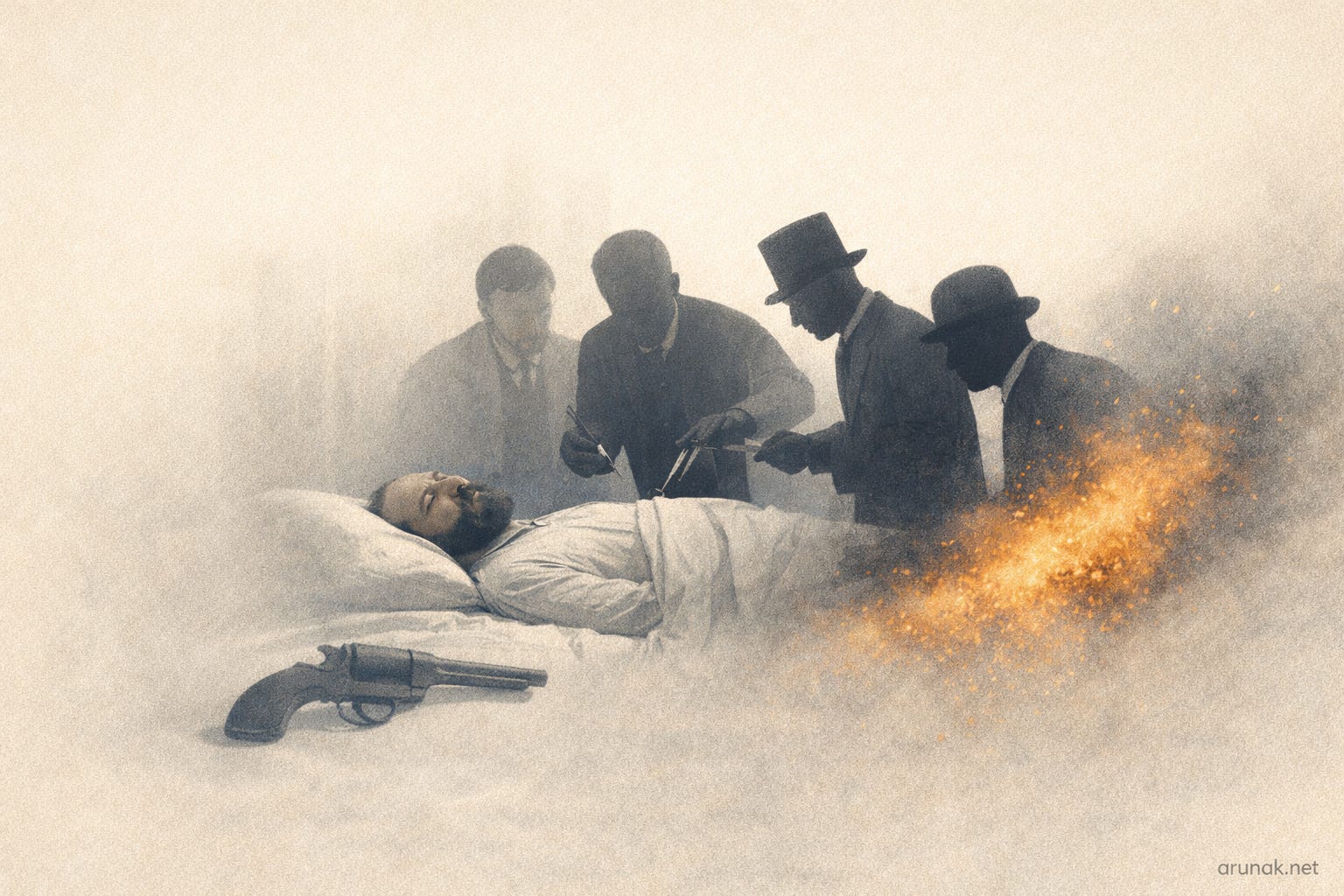
The Story phase
Candice Millard writes in her book Destiny of the Republic:
“Although there were many deaths in the late nineteenth century that even the most skilled physicians could not prevent, Garfield’s was not one of them. In fact, following his autopsy, it became immediately and painfully apparent that, far from preventing or even delaying the president’s death, his doctors very likely caused it.”
So..the bullet is the headline, but the treatment is what made all the mess.
In stressful moments, we love clean causes. A single villain. A single event. Something you can point to and say, “ That’s what did it. But Garfield’s story is brutal in a really subtle way. The thing that arrived first was survivable. The thing that followed was what led to chaos.
And the most unsettling part is that the doctors were not trying to harm him at all. They were just...responding. They were doing what the moment demanded in public. They were acting inside a system that equated action with competence.
So here is the problem I keep coming back to.
When something hits you fast, how do you tell whether the danger is the event itself or the reaction you are about to set in motion?
The Structure phase
Under pressure, decisions stop being neutral. They become performances. Not because people are evil, but because stress changes what “good” looks like in the room.
A simple model:
The shock creates a stage. A crisis makes everyone watch. The system starts rewarding speed, certainty, and visible movement.
The response multiplies touchpoints. More people, more meetings, more hands on the problem. Each hand adds risk, even when intentions are good.
The second-order effects do the real work. The original event is one input. The response creates the cascade. Then the cascade becomes the outcome.
A small change in how we react to an event can produce a huge change in what actually happens next.
The interface
Garfield’s doctors are escalating intervention ≈ in a stressed system, escalating response.
The implication is not that action is bad or that help is dangerous. It is that outcomes often belong to the reaction chain more than the original trigger, especially when reputation, hierarchy, and time pressure start steering the room.
Interface question: When a problem hits at work or in a relationship, what part of your response is for the problem, and what part is for the audience that you think is watching you?