


We are living in such extraordinary times.
Access to knowledge has never been this widespread. We can just learn how to get good at almost anything by clicking a few buttons. What a time to be alive!
But it’s so easy to overlook the fact that what “good” means is also changing.
If everyone is good, nobody is.
In this era of such great abundance, the pursuit of being good, paradoxically, push us back into the average.
Huh! That’s not ideal.
Is there a way to break free from this self-defeating loop?
How to find your place in this rapidly changing world, create leverage, and make a real difference: that’s what this week’s newsletter is about.

For someone who was raised on an old farm up in the sticks near a small town called Kosciusko, Mississippi, Oprah Gail Winfrey had her sights set on much bigger things from a very young age. She had a flair for performing in front of an audience and quite naturally felt at ease around people. At just three years old, she was reciting poems and Bible verses in her local church. She dreamt of becoming a persuasive speaker and was always on the lookout for people whose voices could sway an audience, one of whom was Barbara Walters, a broadcaster on NBC’s Today show at the time. Walters’s composed and authoritative broadcasting style captivated her.
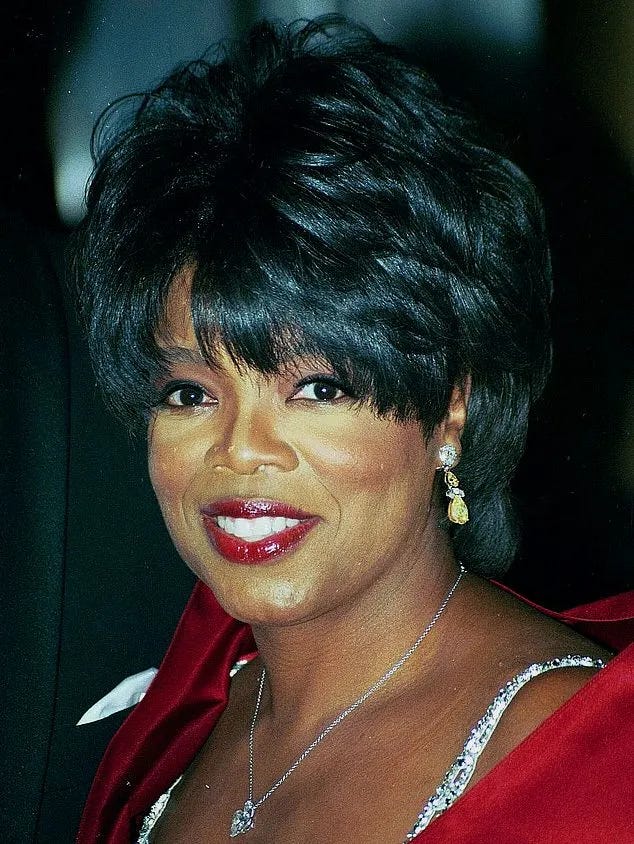
This admiration eventually got her her first big break when she entered the Miss Fire Prevention Contest in Nashville at just sixteen years old. When it came to her turn to answer the question, “What would you like to be when you grow up?” Oprah answered with a deep and composed accent, mimicking Barbara Walters: “I would like to be a journalist. I would like to tell other people’s stories in a way that makes a difference in their lives and the world.” Her words, and the tone in which she delivered them, certainly didn’t go unnoticed.
She won the competition.
To collect her prize, she went to the local radio station. While giving a tour at the station, a staffer would just casually ask her: “Do you want to hear your voice on tape?” Oprah agreed. As soon as she started to read, people started gathering around her, struck by her deep and soothing voice. She was hired on the spot as a reporter.
Only two years later, at just 19 years old, Oprah Winfrey became the first black female anchor in the city. Now, as a local news reporter, she was assigned to cover a whole range of local stories, including tragedies and their aftermath: house fires, funerals and so on. Her dream had finally come true.
But she soon came to realize that there was a fundamental mismatch between her personality and this job. Her aim had always been to influence people. To be a voice of compassion. And neither this composed, polished voice she had adopted nor her job reporting on tragedies gave her the freedom to do that. Soon, she found her job incredibly stressful. And it showed. “She was more concerned with the human involved than the story itself,” recalls the news director Chris Clark. After just eight months, on April 1, 1977, she was demoted from her job to cover short, early-morning news updates.
Oprah Winfrey had hit a dead end in a job that she had always dreamt of loving.

The situation that Oprah found herself in is as dangerous as it is commonplace. When we hit a dead end like this, it’s so tempting to jump to the conclusion that we are in the wrong career. So we change it. But over time, we may come to realize that the new one is even a worse fit than the one before. And so the vicious cycle continues in search of a “perfect career”.1
But, in reality, the way we are going about our job might be the real culprit, as Oprah’s story shows. She loved presenting to an audience. That’s what she wanted to do from a very young age. And evidently, she was good at it too. But the way she approached it didn’t align with her personality.
Like so, early stages of a career are often embarrassing in hindsight. We naturally try to imitate the ones we looked up to growing up. To quote jazz musician Miles Davis: “Sometimes you have to play a long time to be able to play like yourself.” Nothing particularly wrong with taking a few cues from our idols, of course. But if we don’t know how to control it, we risk losing ourselves in the process. No matter how much we admire our idols, at the end of the day, we are not them. Both nature and nurture have shaped our personalities in such unique ways that we can’t just expect to fit neatly into someone else’s mold. It’s never going to happen. We will eventually feel the strain of trying to squeeze ourselves into it.2
And the good news is, we don’t really have to. Because the world appreciates the complete opposite. People just want you to be yourself. In fact, if they sense that you are not being your true self, their interest in whatever you do slowly fizzles out, no matter how good you are at what you do.3 This is exactly the situation Oprah found herself in. She was a gifted child, the youngest TV news anchor in Nashville. Needless to say, she was an exceptional talent. But her talent got overshadowed by her attempt to be someone that she’s not.

Later that same spring, after Oprah was demoted from her job, Bill Baker, the station’s new general manager, was looking for a host for a new show: “People Are Talking”. He needed a host whose voice and personality were more open and warm than those of a typical news reporter.
Oprah Winfrey fit the bill!
But even after accepting this job, she struggled to find her own voice. She was still hemmed in by the rigid, authoritative style she had forced herself into at the beginning of her career.
But all that came to a halt during a live broadcast when she was reading out a list of foreign countries. Among them was the country Canada, which she mispronounced as “ca-NAD-a.” “I got so tickled,” she recalled of this live TV moment, “and then I started laughing. I realized that you can laugh at yourself and you can make a mistake and it’s not the end of the world. You don’t have to be perfect.”

From this moment forward, she made a point of being herself, and started to build her new show around her own personality. She wanted to talk to real people, not just to a screen. So she requested a live audience for her show, which was an unconventional choice for the time. Little by little, she became comfortable with being herself on television. “I realized that I can be a much better Oprah than a pretend Barbara,” she later said in an interview. And the audience picked up on this right away. Her TV show would soon expand into an hour-long segment. In September 1985, the show was renamed “The Oprah Winfrey Show”.
The show ran for 25 seasons and became the highest-rated daytime talk show in American history. It won 50 Daytime Emmy Awards, 12 NAACP Image Awards and four People’s Choice Awards. Oprah Winfrey was named one of the “100 Most Influential People of the 20th Century” by TIME magazine.
Reflecting on all the lessons she had learned throughout her long and triumphant career, Oprah Winfrey offered this advice to the graduating class of 2013 at Harvard University: “From time to time you may stumble, fall, you will for sure, count on this, no doubt, you will have questions and you will have doubts about your path. But I know this, if you’re willing to listen to, be guided by, that still small voice that is the G.P.S. within yourself, to find out what makes you come alive, you will be more than okay. You will be happy, you will be successful, and you will make a difference in the world.”
Boswell, W. R., Boudreau, J. W., & Tichy, J. (2005). The relationship between employee job change and job satisfaction: The honeymoon–hangover effect. Journal of Applied Psychology, 90(5), 882–892.
Mitchell, K. J. (2018). Innate: How the wiring of our brains shapes who we are. Princeton University Press.
Markowitz, D. M., Kouchaki, M., Gino, F., Hancock, J. T., & Boyd, R. L. (2023). Authentic first impressions relate to interpersonal, social, and entrepreneurial success. Social Psychological and Personality Science, 14(2), 107–116. https://doi.org/10.1177/19485506221086138